The aircraft of the era did not yet have the structural integrity to withstand the G forces produced by the diving pull-out. However as aircraft technology advanced into the late 20s and early 30s metal airframes replaced wood and the diving attack became possible.
By the mid 1930s most of the major powers were introducing machines specifically designed as dive bombers. The most famous of these being the German Stuka. The Japanese too initiated the development of such a machine with the release of the 11-Shi specification during the summer of 1936.
The Aichi company had launched an aircraft manufacturing endeavor in 1920 and had established a link with the German Heinkle company to gain expertise. Heinkle's He 66 (an export version of the He 50) was to be submitted by Aichi to meet the 8-Shi specification 1933 under the designation AB-9. Nakajima also entered its NAF-2 machine as a competitor in the Navy's contest.
Aichi's submittal was eventually declared the winner and received the designation Navy Type 94 Carrier bomber or D1A1. Production ended for the type with 162 coming off the assembly line before it was replaced by the improved D1A2 (also called the AB-10). This follow-on was a further refinement and possessed an increase in power with its 730 hp Nakajima Hikari 1 engine. A total of 428 of this machine were produced before cessation of production in 1940.
With the success of this first dive bomber under their belt, and a continuing relationship with Heinkle, Aichi launched a successor to the type 94. The production of this new aircraft was to meet the 1936 11-Shi requirement for an all metal shipboard monoplane. Aichi, Nakajima and Mitsubishi all submitted proposals for the competition with approval given to the first two companies to build two prototypes each.
Aichi's new machine was designated the AM-17 and was designed by a team led by Tokuhishiro Goake. The shape of its wing clearly showed it roots to the Heinkle designs. Other well known aircraft possessing this elliptical shape include the He 70 and the He 111. A fixed undercarriage was retained due to the belief that the reduction in drag and the subsequent gains in performance would be offset by in increased complexity of the retraction mechanism. Rear defense would be supplied by a single 7.9mm Type 92 machine gun while a pair of the same weapons were mounted in the cowl for the pilot's utilization. A single 551 lb. bomb was carried under the fuselage and was swung out on a trapeze to clear the propeller when it was dropped. This was latter supplemented by the ability to carry two and still latter four 66 lb. bombs under each wing. Initially the aircraft was powered by a 710 hp Nakajima Hikari 1 nine cylinder radial engine.
The new machine received the Naval designation D3A1 and began its flight testing in early 1938. It was found to be underpowered, prone to snap rolls in tight turns, suffering from directional stability problems and afflicted with sever vibration problems when its dive flaps were deployed. This list of shortcomings necessitated a significant redesign. Most notable was the replacement of the powerplant with the 840 hp Mitsubishi Kinsei 3 fourteen cylinder radial. Also redesigned were the wings, which received an increase in span of 1 foot 3 3/4 inches, and the dive flaps.
With this work completed the Aichi machine was selected over its Nakajima D3N1 competitor. Thus the Navy Type 99 Carrier Bomber Model 11 started toward its combat career. Before operational production was undertaken several other small refinements were initiated in the design of the wing to increase the diving speed and a dorsal "spine" was added to further improve the directional stability. Before production was undertaken the airframe again received an upgrade of the engine, this time being fitted with either the 1000 hp Mitsubishi Kinsei 43 or 1070 hp Kinsei 44. The wingspan was also shaved back a small bit.
The carriers Akagi and Kaga received the first examples for qualification testing in early 1940. Excellent maneuverability and robustness of the airframe coupled with stability during its dive made it very popular with its crews. Several of the craft were able to participate in limited combat during land based operation in China and Indonesia before the outbreak of hostilities with the United States.
The machine's true test of its abilities were to be initiated during the attack of Pearl Harbor. With the only 15 losses due to combat the first large scale use of what the allies would soon code name "Val" could only be considered a huge success. In the following months the plane's maneuverability would allow it to tangle with fighters and have a good chance of surviving and, occasionally, even winning. Other notable success of the type would soon include the attack on Port Darwin in Northern Australia, Columbo Ceylon and the sinking of the British ships Cornwall, Dorsetshire, Hermes and Vampire.
As with the other Japanese success the Val's period of superiority would be very short. Many of the machines, and their valuable crews, were lost during the Battle of the Coral Sea followed by a complete loss of all the type based on the four carriers at the Battle of Midway.
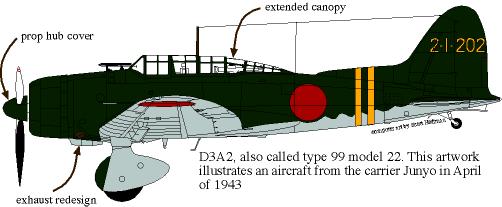
With the war accelerating Aichi undertook a refinement of the model 11. Increasing the fuel capacity, lengthening the canopy over the rear gunner and a few other minor physical changes were embodied in the D3A2 or Navy Type 99 Carrier Bomber Model 22. These changes did little to improve the type's effectiveness or survivability and with the Allies rapidly introducing new tactics and aircraft types flying the Val was soon an unhealthy experience.
With the introduction of the "Judy" the Val was moved to the smaller carriers and as these were sunk the type found itself increasingly fighting in a landbased mode. As improved types of aircraft became available the Val was relegated to training duties and received the designation D3A2-K or Navy Type 99 Bomber Trainer Model 22. Lastly it was used, as with all Japanese types, as a suicide aircraft and provided Marine 1st Lt. Jeremiah O'Keefe with five kills in a single mission on April 22, 1945 as he participated in the defense against mass kamikaze attacks.
With the shortage of aluminum became more sever a wooden version of the D3A2-K was produced. However, the desire to use untrained manufacturing personnel and the need to alter the existing design to better adapt to the idiosyncrasies of wood construction led to the development of the Yokosuka D3Y1-K Myojo (Venus). The elliptical shape of the wing and tail was replaced with straight edges and the rear of the fuselage was lengthened to accommodate a change in the center of gravity. As with many wooden aircraft the prototype significantly exceeded the target weight and was again redesigned to decrease the machine's weight. Only three of the wooden Vals were completed before the end of the war. A single seat suicide version of the wooden machine was also considered and would have been designated D5Y1 but was not produced before the end of hostilities.
In the end the Val suffered the same shortcoming as the dive bombers of all the nations which participated in the conflict, that being an inability to survive without a heavy fighter escort. However its moment in the spot light of history was also secured over the skies of Pearl Harbor in 1941.
References:
Ethell, Jeffrey L., Warren M. Bodie. WWII
War Eagles, Global Air War in Original Color, Widewing Publications, 1995
"Pacific Predator... the Aichi Type 99", Air International, Dec. 1987, p.285
"Aichi Navy Type 99 Carrier Dive-Bomber (D3A)", The Maru Mechanic, 1982 No.5
Francillon, René J., Japanese Aircraft on the Pacific War, Putnam Aeronautical Books, 1987
Mikesh, Robert C., Shorzoe Abe, Japanese Aircraft 1910-1941, Putnam Aeronautical Books, 1990